

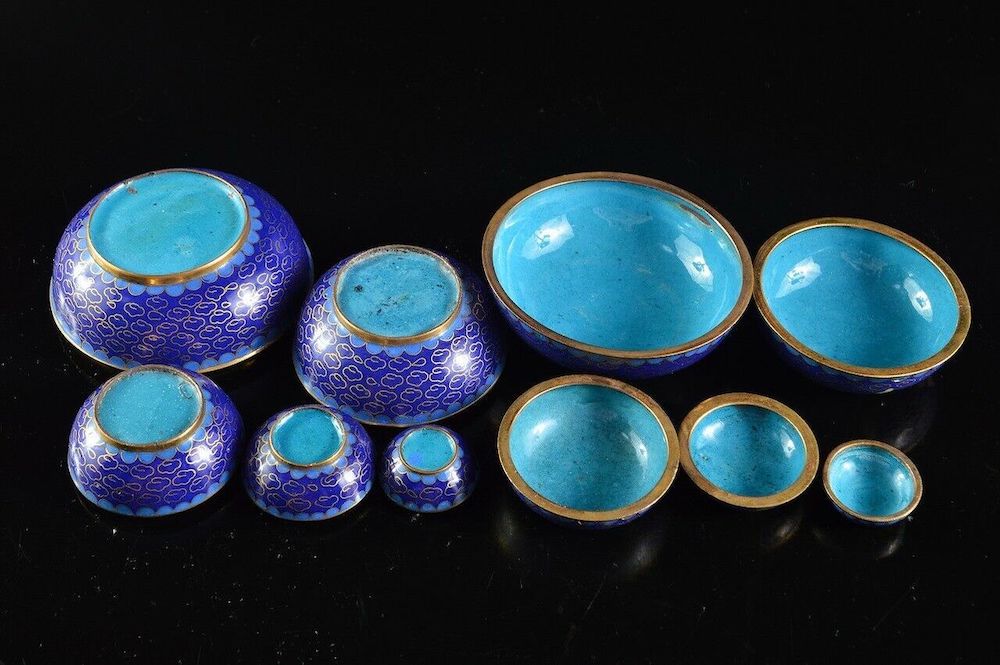


Approximate size L: W3.1″ by H2.0″ or 8.0 by 5.0 cm

This is a set of 5 containers for incense or other valuables, made with the metalworking technique known in the West as cloisonné and in Japan as ‘shippō’. Starting with the largest one, each piece is smaller than the one before and all fit inside each other. In a way these containers are the equivalent of Matryoshka nesting dolls as seen on the right.
All 5 are in the same theme although there are little differences due to the decreasing size. I’m not experienced with cloisonné but in my opinion the work is very fine. Considering how many small pieces of metal are used for each one it is quite impressive when the realisation hits – this is one labour intensive technique!

Amongst the earliest examples of cloisonné are six Mycenaean rings that date as far back as the 13th century BCE! The great Western period of cloisonné enamelling spanned from the 10th to the 12th century, especially in the Byzantine Empire there emerged a particularly high mastery over the technique. In China cloisonné was widely produced during the Ming and Qing dynasty. In Japan it was especially popular during the Tokugawa and Meiji period.
Ming (1368–1644)
Qing (1644–1912)
Tokugawa (1603–1868)
Meiji (1868–1912)
It is said that during the early Edo Period, Hirata Hikoshiro also known as Hirata Donin (1591-1646), learned the art of cloisonné enamelware or shippō, from a Korean visitor to Japan and that he subsequently applied colours to the concave surfaces of such pieces. Hirata was the founder of the craft in Tokyo and while working in the service of the Tokugawa Shogunate, he created many famous works. Successive generations of the Hirata family resided in Edo while guarding their secret shippō techniques, until the early Meiji Period.

When the Fifth International Exposition was held in Paris in the third year of the Keio Era (1868), the Shogunate dispatched a delegation to represent Japan and assert the country’s influence abroad. During the event, delegation members from the Satsuma Domain (modern Kagoshima Prefecture), had an honorary medal created called “the Order of Satsuma”. This decoration was modelled after the French Legion of Honour. It was subsequently presented to Napoleon III and it received high praise. This act raised the awareness of honorary decorations, which led the Council of the Left, the predecessor of the new Meiji Government’s Chamber of Elders, to discuss the establishment of a Japanese honours system. In the sixth year of the Meiji Era (1873), the Chamber of Elders requested that a mint produce medals for such an honours system; however, the mint workers lacked experience in enamelware production techniques (shippō). This led the government to ask the well-known Hirata family who had worked for the Edo Shogunate for assistance. A prototype award was completed by Hirata Haruyuki and this eventually became the medal bestowed along with the award of the Order of the Rising Sun.
All five are unused and condition is excellent. This snugly family of cases do not come with a box. For shipping they will be wrapped in a soft piece of cloth to protect the delicate work.
€225 + shipping cost

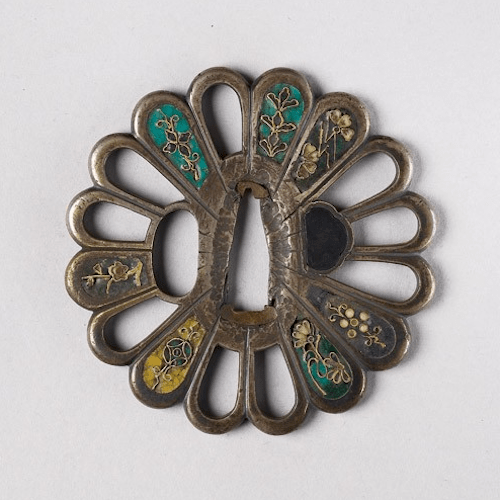
On the right, a tsuba (Japanese sword guard), in the shape of a chrysanthemum badge of 16 voided florets; in the case of seven the openwork is filled in with cloisonné enamel.
by Albert James Koop
