


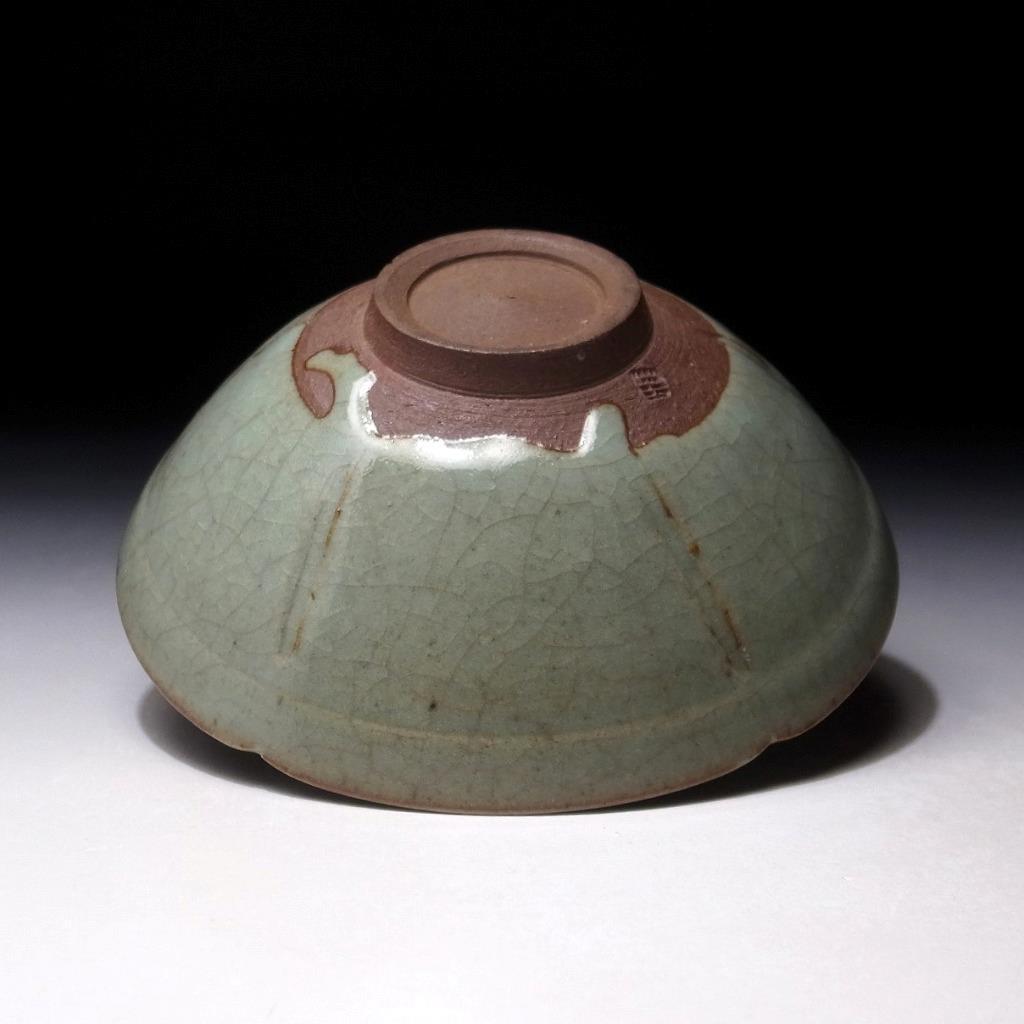

Potter: Masao Nakajima
Approximate size: W5.9″ by H2.2″ or 15.0 by 5.6cm
This is a delicately shaped chawan with a gorgeous celadon glaze by one of stars of Gifu prefecture, Intangible Cultural Treasure potter Masao Nakajima (1921-). He studied under master Hineno Sakuzo (1907-1984), after which he went independent. Working from his kiln Gazan-gama in Gifu prefecture, he received the title of Human Intangible Cultural Treasure of Toki City in 1987. Masao Nakajima worked in an amazingly wide range of styles, including but not limited to: Shino, guro-Seto or black Seto, ki-Seto or kuro hikidashi-Seto (yellow Seto), oribe, over-glaze enamels and at one time even produced Goryeo-style celadon porcelain (such as the example featured here). His tea bowls are well regarded and this chawan substantiates the notion. This chawan with its lobed rim bears some similarity to one of the most famous celadon tea bowls called Bakohan. A chawan designated as a National Treasure of Japan, housed in the collection of the Tokyo National Museum.
Pottery has been produced in the Mino area of Gifu prefecture since the Kamakura period (the end of the 12th century). The main names synonymous with Mino are Oribe, Shino and ki-Seto. It is said that Shino was the first ware to decorate its pieces with brush-drawn designs. Before the use of brush-drawn decorations potters had been carving, incising or were appliquéing their designs and motifs.

Masao Nakajima‘s work was first selected at the prestigious Nitten Exhibition in 1956. In 1957, his work was selected for the Asahi Modern Ceramics Exhibition and the year after he won an award at previously mentioned exhibition. In 1963 his work was officially purchased by emperor Showa and he was appointed as a selection committee member at the Asahi Ceramics Exhibition. In 1987 he was designated as an Intangible Cultural Treasure of Gifu Prefecture by the Ministry of Economy, Trade and Industry and formed the Mino Ceramics Association.
Seiji or celadon is a glaze that usually turns to a jade green colour. The firing of the iron in the glaze produces its beautiful colour, which is brought out by reduction firings in a kiln at temperatures exceeding 1200°C. The origin of celadon stoneware lies in China where during the Tang Dynasty (±618 till ±907), production started and found a willing and wealthy client base amongst the elite and intellectuals. A little later during the Sung Dynasty (±960 till ±1279), the supply lines for the resources used in celadon wares became stable which caused export of celadon ceramics all through out eastern Asia and eventually to Japan around the 11th century.
Adding to its popularity was a widely believed superstition suggesting that a celadon dish would break or change colour if poisoned food were put into it.
The chawan is devoid of chips and cracks and condition is excellent. Accompanied by the original quality paulownia tomobako or storage box that bears the artist’s calligraphy and seal on the lid and includes a dedicated tomonunu, tea-cloth.
SOLD
Thank you very much!


Mino ware refers to pottery produced in what was formerly the old Mino Province. Early examples of Mino ware were predominantly ash-glazed stoneware pieces. Later however the use of the potter’s wheel, as well as a greater variety of glazes, began to characterize what is often thought to ideally represent Mino pottery today. Larger production kilns like Kozan-gama in Gifu Prefecture produce wares similar to Imari and Arita-ware. Various other kilns specialise in producing budget priced tableware, along with high end wares for various brand name stores and franchises around the country such as Tachikichi in Kyoto.
