


Potter: Miyashita Zenji

Approximate size: W2.8″ by H1.2″ or 7.2 by 3.0 cm
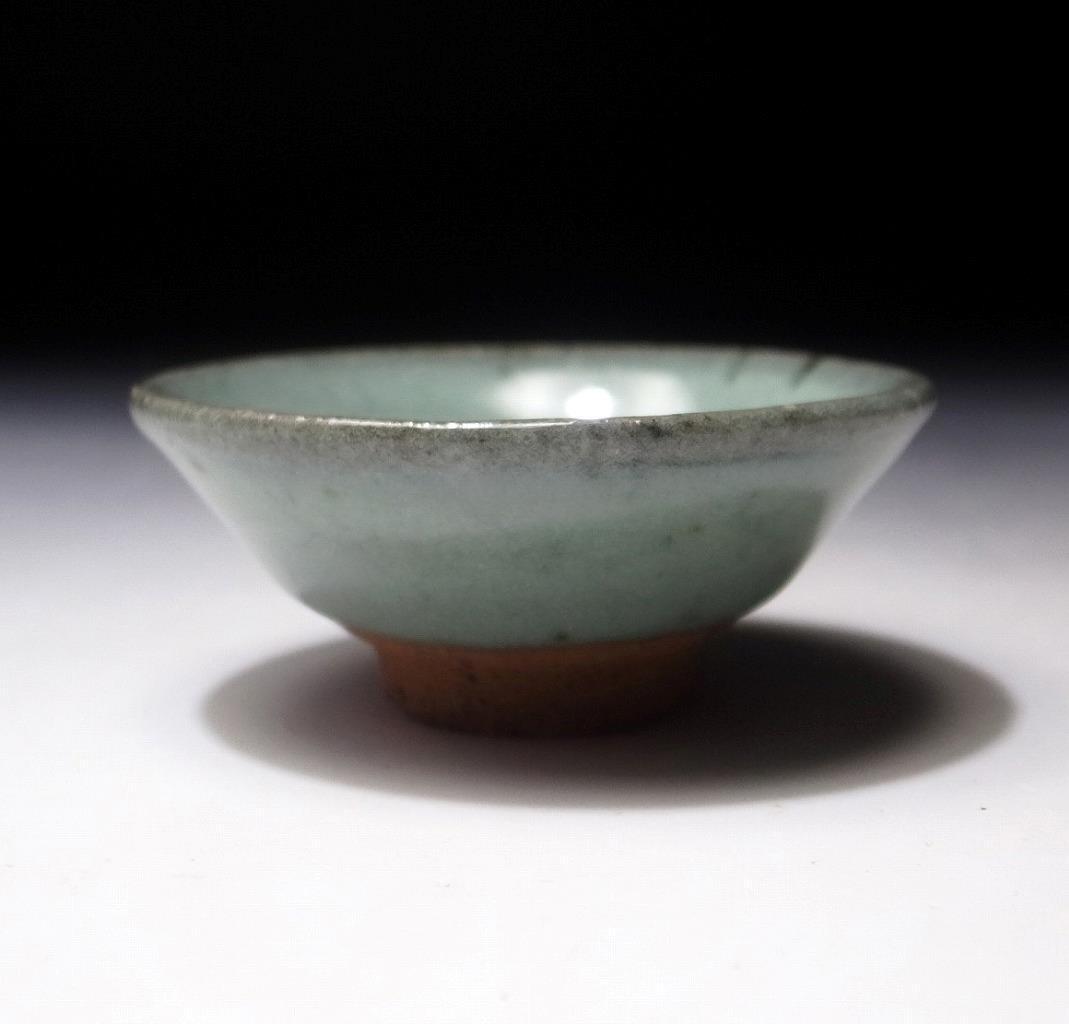
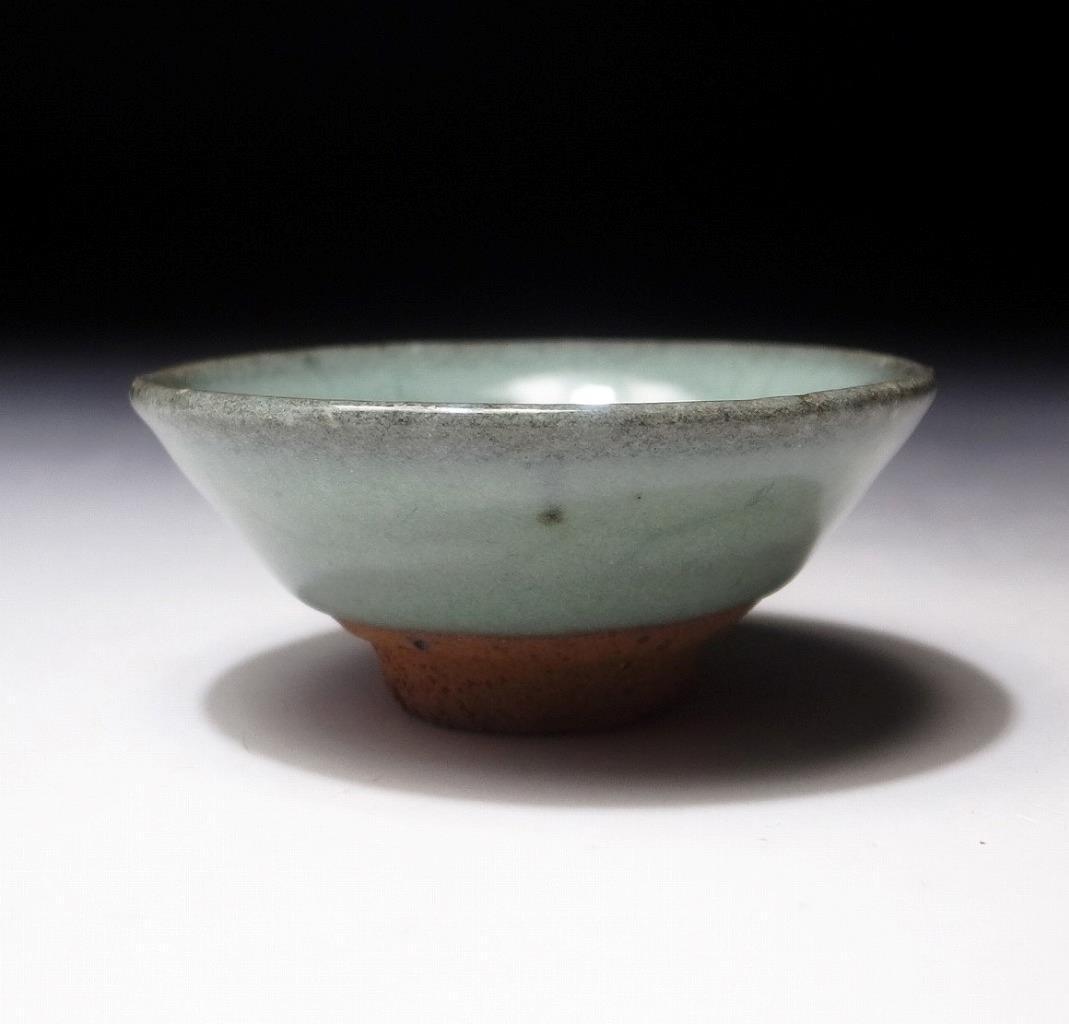
This is a seiji celadon guinomi or saké cup by world renowned artist Miyashita Zenji (1939-2012). As the eldest son of master potter and porcelain artist Miyashita Zenju (1901-1968), he went to Kyoto Municipal University of Arts and studied with no less than two Living National Treasures, namely Tomimoto Kenkichi and Kondo Yūzō. As an independent potter he worked with and was inspired by artists like Yagi Kazuo, Suzuki Osamu and Kiyomizu Kyūbey. Miyashita was affiliated with Seitōkai and the Nitten group (starting in 1964), exhibiting in their annual competitions (which he won 18 times!). His works have been included in exhibitions throughout the world and were acquired by nearly all the major museums in Japan, the US and Europe. It is no exaggeration to say he was one of the most famous potters of Japan.
Works by Miyashita Zenji are held in the Freer-Sackler, the British Museum, the Metropolitan Museum of Art New York , the Brooklyn Museum, the Minneapolis Institute of Arts, the Museum of Fine Arts Houston and of course the National Museums of Modern Art both in Kyoto and Tokyo among a host of others.
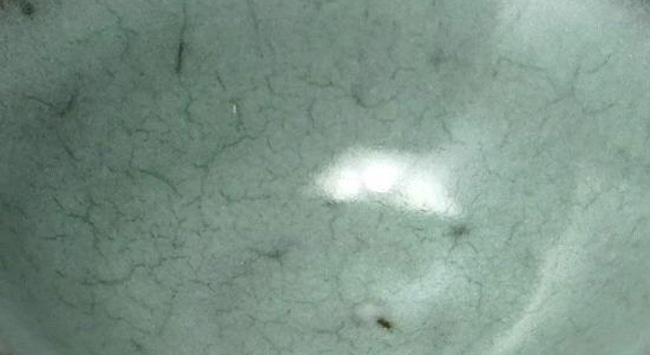
At the beginning of his career he started with celadon glazing, considered to be one of the most difficult types of glaze as it relies heavily on shape and extreme control of firing and kiln to result in flawless pieces. The subject guinomi would likely be estimated to date from early in his career. However due to the absence of a date, upon careful assessment may very well stem from later in his career.
Seiji or celadon is a glaze that usually turns to a jade green colour. The firing of the iron in the glaze produces its beautiful colour, which is brought out by reduction firings in a kiln at temperatures exceeding 1200°C. The origin of celadon stoneware lies in China where during the Tang Dynasty (±618 till ±907), production started and found a willing and wealthy client base amongst the elite and intellectuals. A little later during the Sung Dynasty (±960 till ±1279), the supply lines for the resources used in celadon wares became stable which caused export of celadon ceramics all through out eastern Asia and eventually to Japan around the 11th century.
Adding to its popularity was a widely believed superstition suggesting that a celadon dish would break or change colour if poisoned food were put into it.

Works by Miyashita Zenji are held in the following (non-exhaustive), list of public museum collections
Aichi Prefectural Museum, Japan
Asian Art Museum, San Francisco, CA
Auckland Art Gallery, New Zealand
British Museum, London, UK
Brooklyn Museum, NY
Carnegie Museum of Art, Pittsburgh, PA
Chazen Museum of Art, Madison, WI
Everson Museum of Art, Syracuse, NY
Herbert F. Johnson Museum, Ithaca, NY
Indiana University Art Museum, Bloomington, IN
Japan Foundation, New York, NY
Kyoto Municipal Museum of Art, Japan
Kyoto Prefectural Library and Archives, Japan
Metropolitan Museum of Art, New York, NY
Minneapolis Institute of Art, MN
Musée Cernuschi, Paris, France
Musée des Arts Décoratif, Paris, France
Musée National de Cèramique, Sèvres, France
Museum of Ceramic Art, Hyogo, Japan
Museum of Fine Arts, Boston, MA
Museum of Fine Arts, Houston, TX
Museum of Modern Art, Shiga, Japan
Museum of Modern Art, Wakayama, Japan
Museum of Oriental Ceramics, Osaka, Japan
National Museum of Asian Art, Washington, DC
National Museum of Modern Art, Kyoto, Japan
National Museum of Modern Art, Tokyo, Japan
Newark Museum, NJ
Peabody Essex Museum, Salem, MA
Philadelphia Museum of Art, PA
Portland Museum of Art, OR
Royal Ontario Museum, Toronto, Canada
St. Louis Museum of Art, MO
Shigaraki Ceramic Cultural Park, Japan
Spencer Art Museum, Lawrence, KS
Stiftung Keramion, Frechen, Germany
Worcester Art Museum, MA
His mature work was a modern embodiment of a classic Kyoto mode associated with the Heian period (which started in the year 794 and lasted until 1185). He applied delicate layers of colour — reminiscent of multilayered court robes or decorated papers made for inscribing poetry — using not over-glaze enamels or glazes but clay itself, dyed with mineral pigments. This technique became known as saidei (coloured-clay overlay). The saidei technique in Miyashita Zenji’s case meant the application of extremely thin layers of delicately gradated coloured clay in irregular bands to cover the surface of each sculptural vessel or form, transforming the surfaces into for instance; landscapes featuring distant hills, drifting clouds or rolling waves.
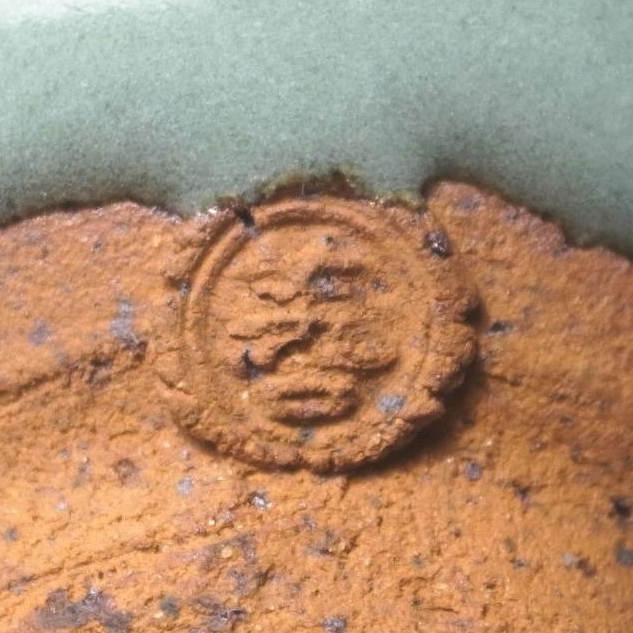
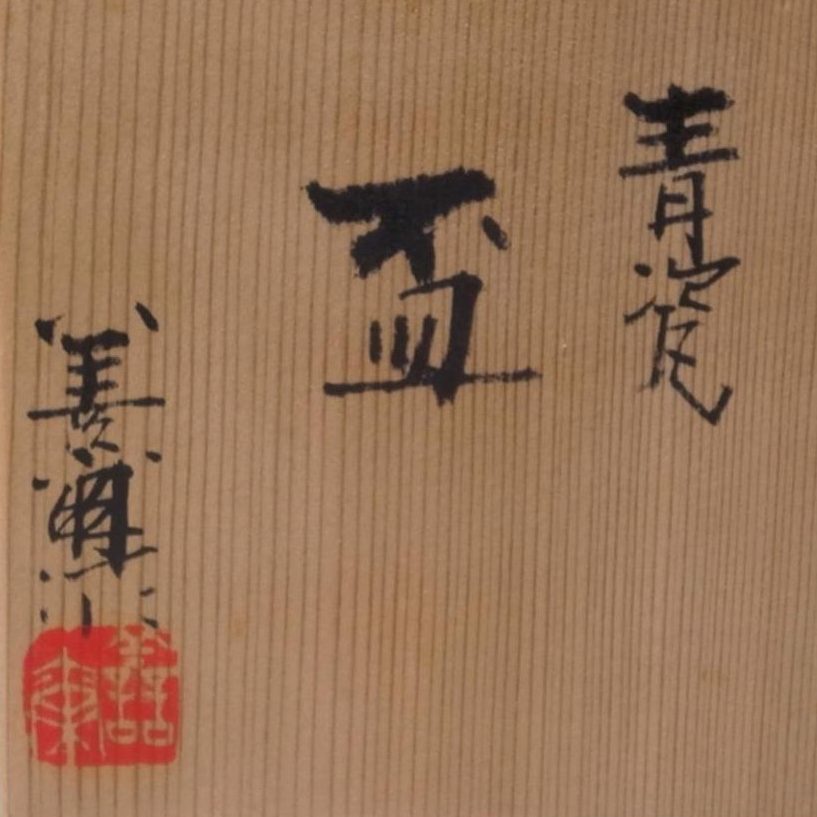
The guinomi bears the potter’s stamp next to the koudai or foot-ring. There are no chips or cracks condition is mint. Comes complete with the original quality paulownia tomobako or wooden storage box with kiln stamp, calligraphy & artist signature on the lid.
Also comes with a dedicated tomonuno or tea-cloth. Stamped with another of Zenji Miyashita’s seals, one different from the red stamp as seen on the box-lid. A good reference too as I haven’t seen it before in Miyashita Zenji’s work.
€280 230 + shipping cost