


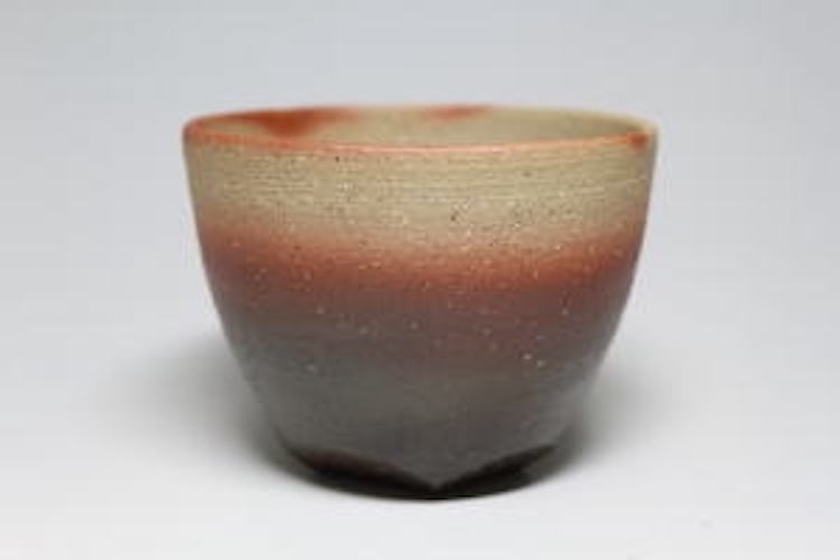

Potter: Kenji Takenaka
Approximate size: W 3.7″ by H 3.0″ or 9.5 by 7.5 cm
This is a Bizen yunomi or Bizen tea cup featuring hidasuki firing effects by one of my favourite potters; Kenji Takenaka. Wheel thrown half cylinder shape with a hand carved, 5 sided foot. Holding this cup in your hands it will quickly become a favourite piece as its smooth to the touch and masterfully shaped to connect. This work is more traditional in a sense than most works by this potter. As characteristic for Bizen pottery, the cup was wood fired without glaze, it features heavy hidasuki colours on the foot and lighter shades of red alongside the rim and interior valley. Hidasuki is one of Bizen pottery main features and is created by strapping works with rice straw before firing. Further techniques influencing the outcome have to do with kiln placement, types of wood used for the firing and control over for instance oxygen levels (or lack thereof), during the firing process.
Kenji Takenaka was a jeweller and made the switch in the middle of his career and is now a full fledged potter. Even though starting potting late in life, he is now highly acclaimed and works hard to come by. His work is detailed and shaped with the same level of care as I imagine his jewellery shows. Hard to describe, this potter won me over the first time I held one of his cups. Bizen wares are fired slowly over a long period of time. Firings take place only once or twice a year. They require the kiln fire to be kept lit and burning for approximately 10 to 14 days involving long hours and literally tons of wood.
Bizen is one of the six oldest remaining Japanese pottery traditions where for more than a thousand years, potters have been producing a sober yet strong looking wood fired ceramic. This rustic pottery whose age gives it a noble air is still popular today in Japanese homes and restaurants alike.
Bizen ware is a type of Japanese pottery most identifiable by its iron-like hardness, reddish brown colour, absence of glaze and markings resulting from wood-burning kiln firing. The clay used for Bizen ware has a high iron content and traditionally has a lot of organic matter in it that is not receptive to glazing. The clay can take many forms while retaining its strength. The surface treatments of Bizen wares are traditionally entirely dependent on yohen or kiln effects produced by the wood firing. Pine ash produces goma, or “sesame seed” glaze and rice straw wrapped around pieces creates red and brown scorch marks called hidasuki. The placement of pieces in a kiln causes them to be fired under different conditions, with a variety of different results. Considering that one clay body and type of firing is used, the variety of results is remarkable.

1957 Born in Okayama city
1988 He studied under Jun Isezaki who was designated as Living National Treasure
He received a prize in the Issuikai exhibition
1989 He received a prize in the moulding exhibition of the tea ceremony at the Tanabe Museum of Art
Subsequently awarded the prize 4 more times
He received a prize in the Asahi ceramic art exhibition
He received the Encouragement Prize in the Okayama art exhibition
Subsequently awarded the Encouragement Prize twice more
He received Sanyo Newspaper Publisher Prize in the Japanese Traditional Art Crafts Exhibition, Chugoku Area
1990 He received a Prize of Prefecture in Okayama art exhibition
Subsequently awarded the Prize of Prefecture twice more
He received a prize in the Japanese Traditional Art Crafts Exhibition at Chugoku Area
Subsequently awarded the prize 5 more times
1991 He received a prize in Okayama art exhibition
Subsequently awarded the prize 6 more times
He publicly received a prize in Yakishime Pottery exhibitions
1993 Build a hole, semi-underground type kiln in Kibi chuo-cho, Okayama prefecture
1994 Fired kiln for the first time
1995 He received a Mayor Okayama Prize in Okayama art exhibition
He held a private exhibition at Kurodatouen Ginza
Subsequently awarded the prize 6 more times
1997 He held a private exhibition in studio Ikuko
Subsequently held another exhibition at this venue
He received a prize in the Japanese Traditional Art Crafts Exhibition
After that he was awarded the prize once more
1998 He held a private exhibition at the Tenmaya in Okayama
2000 He held a private exhibition at the Bizen Gallery Aoyama
After that it was held 4 more times
2005 He submitted to the Japan and France modern Ceramic Art Exhibition
2006 He held a private exhibition at Bunkindo
2007 He held a private exhibition at the Gallery Tosei
Held private exhibition at the same venue twice more
2008 He held a private exhibition at the Gallery Matsuyama
2010 He held a private exhibition at Mitsukoshi in Nagoya
2011 He received a Sanyo Newspaper Publisher Prize in the Japanese Traditional Art Crafts Exhibition of the Chugoku Area
He received a special award of Prefecture in Okayama Art Exhibition
2012 He received a Mayor Okayama Prize in the Japanese Traditional Art Crafts Exhibition of the Chugoku Area
2013 He joined in the Japanese Traditional Art Crafts Exhibition of Chugoku Area
This yunomi is signed on the foot. There are no chips or cracks and condition is excellent. Does not come with a box.
SOLD
Thank you very much!


Main styles of Bizen pottery
Botamochi 牡丹餅 (rice ball)
round, often red spots created through surface masking, kiln placement and wood firing
Goma 胡麻 (sesame seed)
glaze produced by kiln placement and ashes melting in the heat of the kiln
Hidasuki 緋襷
a rice straw wrapping, containing salt, typically producing bands of red colour
Ao Bizen 青備前
acquires various blue hues due to wrapping with rice straw, kiln placement and reduction during wood firing
Sangiri 桟切り
shiny metallic blue sheen acquired, often randomly through reduction during wood firing
Kuro Bizen 黒備前 (black Bizen)
black colours achieved through use of clay and kiln placement, typically associated with ancient Bizen ware made in Imbe village during the 12th century
