
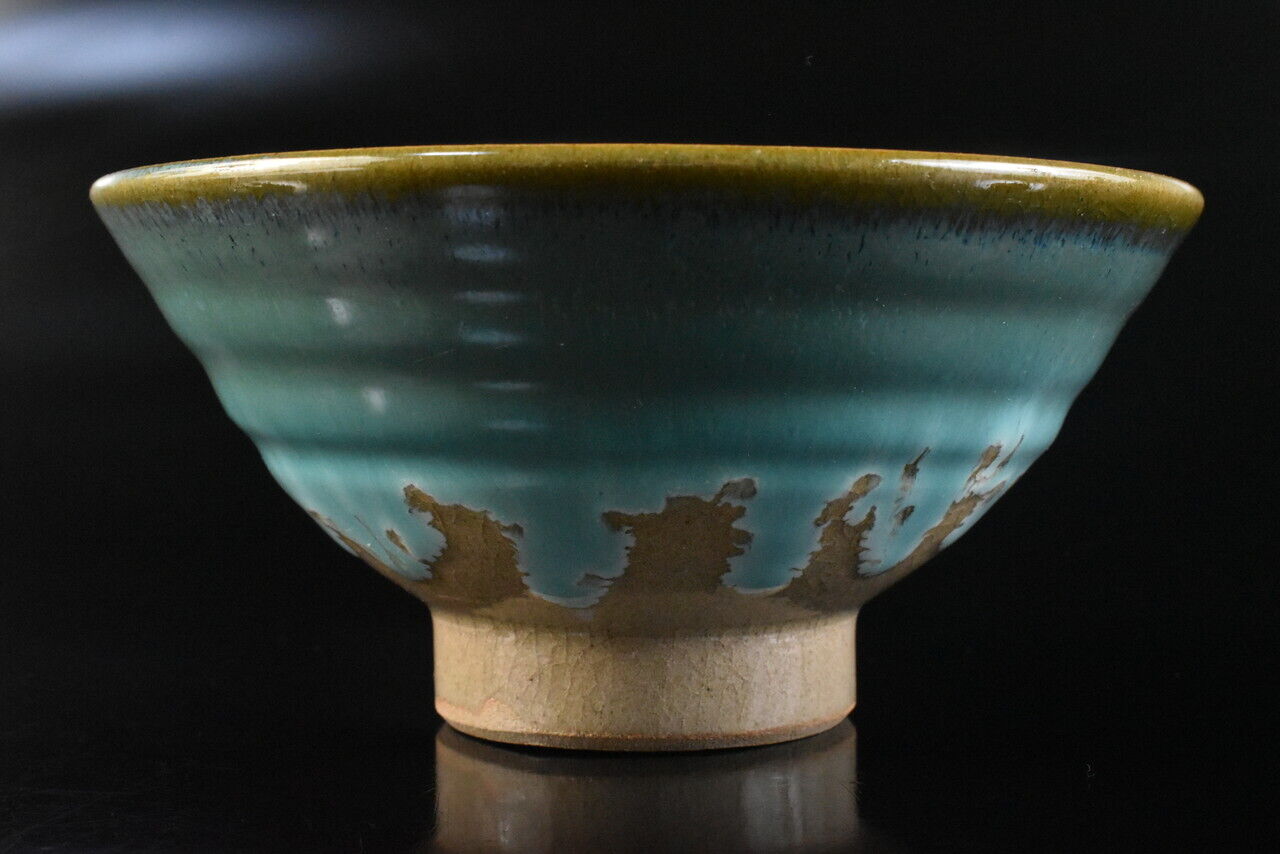
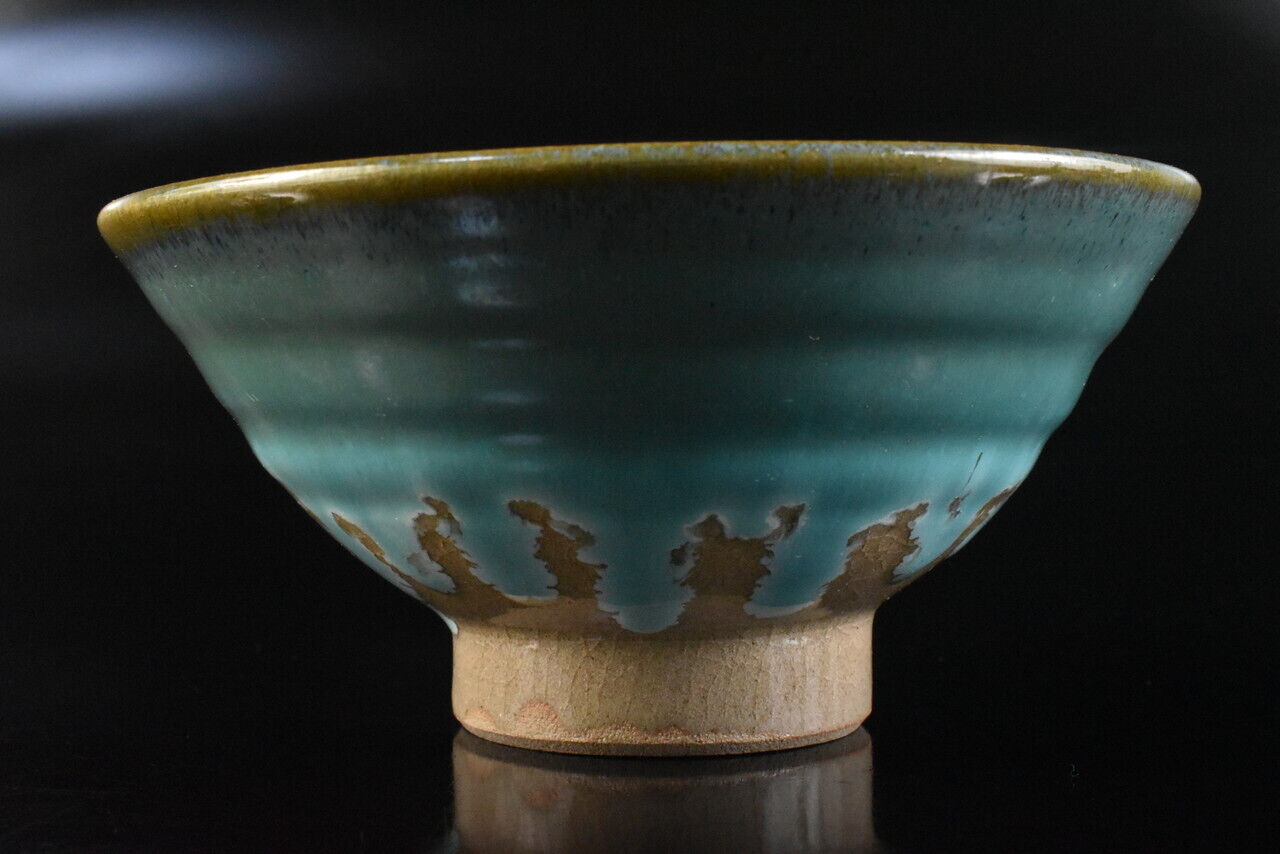
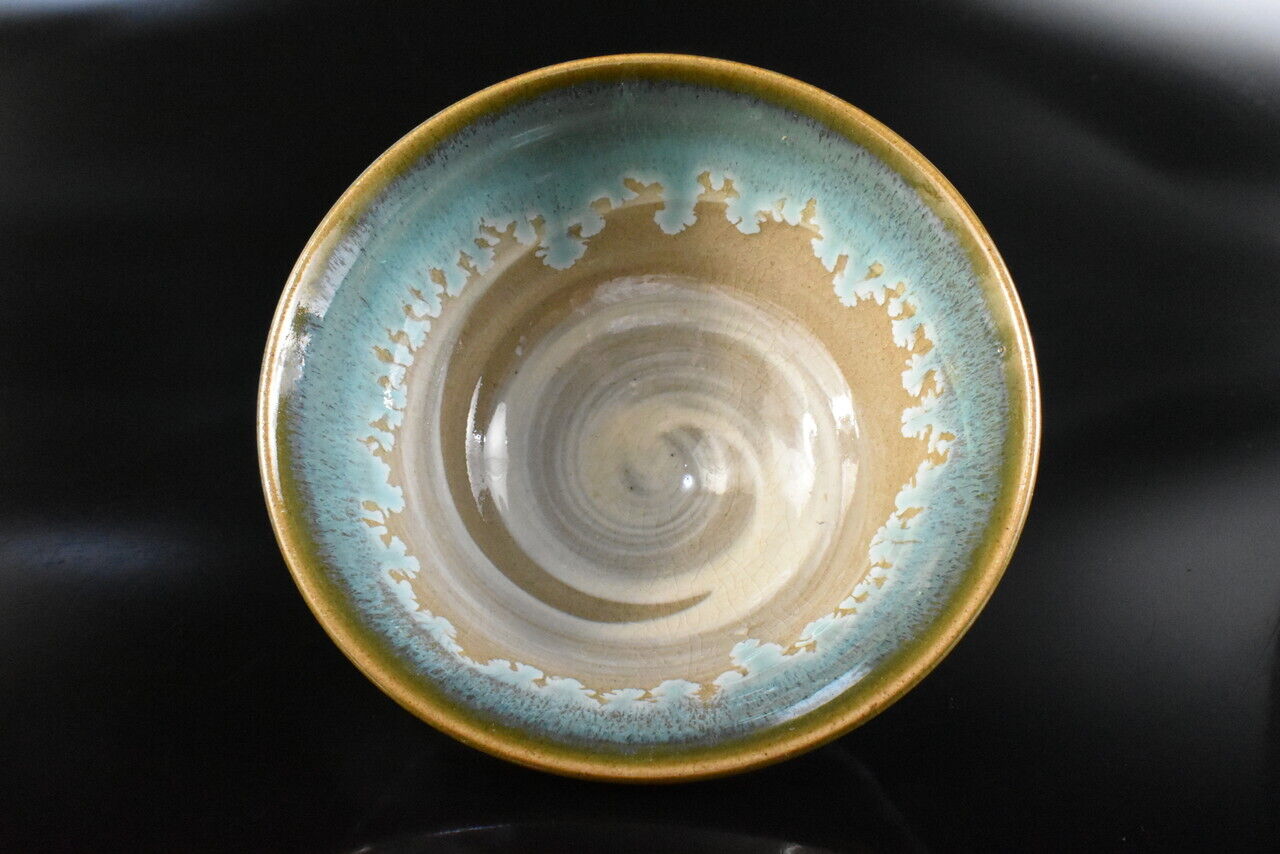

Approximate size: W5.5″ by H2.6″ or 14.0 by 6.7 cm
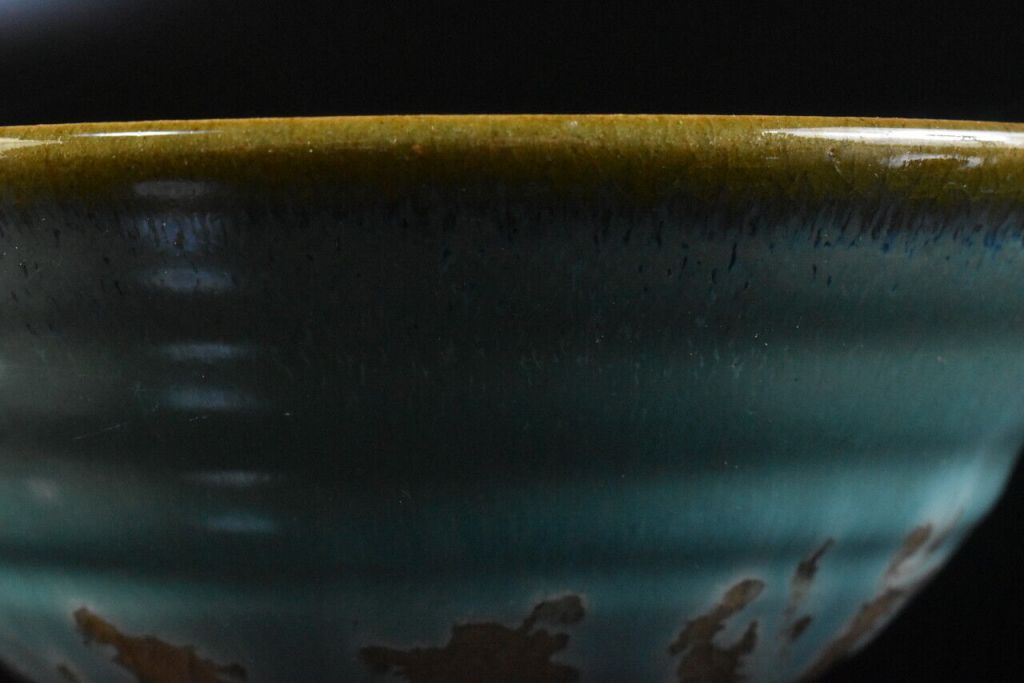
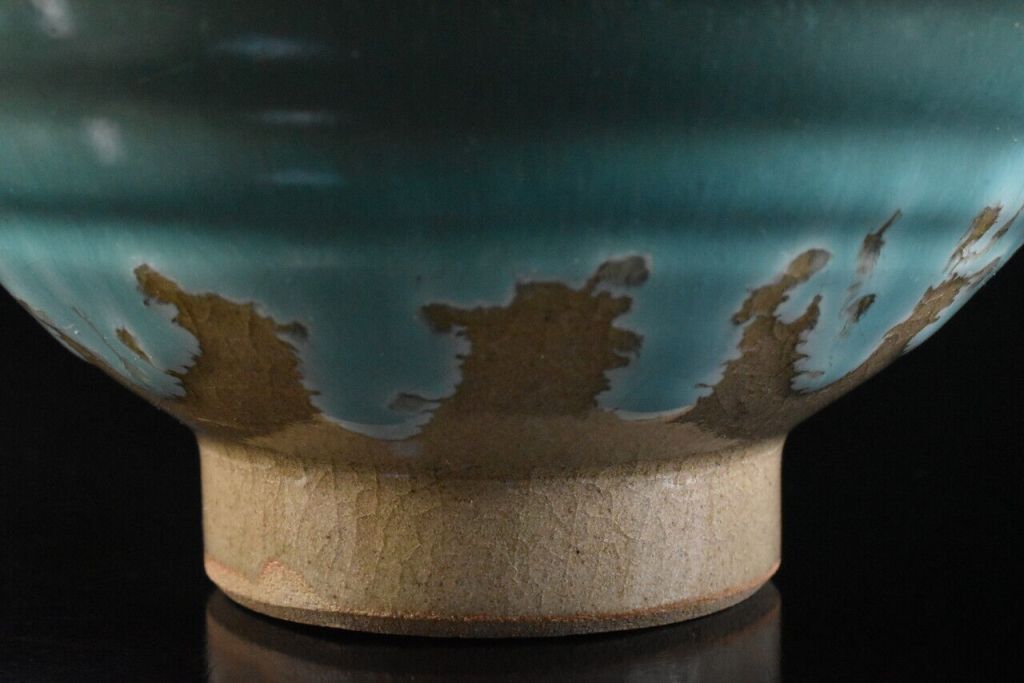
This is an Agano chawan or ceremonial tea bowl with a dual kind of glaze. Foremost the characteristic green that is a tell tale sign of this type of pottery which is overlaid on a classic white ‘hakeme‘ or brush stroke design. The formations as seen on the edges of agano’s green glaze remind me of a famous, perhaps thé most famous fractal known as the mandelbrot set. The Mandelbrot set is a two-dimensional set with a relatively simple definition that exhibits great complexity, especially as it is magnified where curiously it continually repeats itself at all levels. This chawan is a particularly fine example.
Agano ware is made in what is modern day Fukuoka prefecture. Specifically it is said to have arose in 1602, in and around Fukuchi, Kawara and Ōtō town, in Tagawa district. It was counted as one of the Enshū nana gama during the Edo period because it was loved by tea masters and enthusiasts alike. Agano ware specializes lie in its variety of enamels used and yohen effects which are changes natural patterns produced by the glaze interacting with the fires of the kiln.
Old Agano ware chawan are are mostly mumei (unsigned or without any maker’s mark). Few are signed with potter’s name and there are even fewer which bear a date. Starting at the end of the Edo period the Agano ware was being marked with the spiral or ‘tomoe‘.
Until the early 17th century, right-handedness and left-handedness coexisted and were not constant, although a study reported that the left-handedness was constant for works in the upper part of the pottery between 1804 and 1830. Later, after the Meiji era, the style was changed to a kiln marking.
Agano yaki or Agano ware further interested me due to its relation to well known samurai and historically important figures such as Hosokawa Tadaoki. A Daimyo during the end of the Sengoku Period (starting in 1467 and ending in 1568, is also known as the Warring States Period), and lord of Miyazu Castle in Tango. He was the founder of the Higo clan and first Daimyo of Buzen province (Kokura domain).
At the start of the Edo period Hosokawa Tadaoki was born under the Hosokawa name (a branch of the Ashikaga family). He grew up a samurai and became a well-known practitioner of the Tea ceremony. After shogun Ashikaga Yoshiaki was banished – taking the name Haneshiba, Tadaoki became lord of Miyazu castle in Tango and Kumaso province (later renamed to Higo, current Kumamoto prefecture).
After acquiring increasing means through his title and function as lord he summoned a Korean potter Sokai (Agano Kizou). Sokai travelled up to Agano, Toyosaki province at his behest and constructed a workshop. That workshop was effectively the start of Agano ware.
Interesting to note is the 79th prime minister Hosokawa Morihiro is descended from the Hosokawa clan.
Enshū favoured a number of Japanese tea utensils and discussed these at length with friends, connoisseurs of tea and lords of provinces which were home to the kilns. It is assumed that Enshū also had work made on commission which helped with establishing some of the newer kilns during that time. At the same time he also build long-term relationships with the older sites. A list in itself did not exist but was compiled after this death based on his correspondence and the knowledge which kilns he preferred to be a patron of. The earliest mention of his list is from a late Edo period book from 1857 called “Historical Investigation into Domestic Ceramics” (Honchō tōki kōshō).
Enshū’s Seven Kilns or Enshū chō (Enshū nana gama), is a list of Japanese pottery kilns which ware’s were considered favourites of Tea master Kobori Enshū (1579–1647).
The seven types of pottery Famous Tea Master Enshu favoured
Asahi ware from Buzen Province
Agano ware from Buzen Province
Akahada ware from Yamato Province
Kosobe ware from Settsu Province
Shitoro ware, later Tōtōmi Province
Takatori ware from Chikuzen Province
Zeze ware from Ōmi Province
The chawan is sealed inside the koudai or foot-ring. There are no chips or cracks and condition is mint. This tea bowl does not come with a box.
SOLD
Thank you very much!


