




Potter: Kamei Masaru
Approximate size: W4.6 by W4.7″ by H3.4″ or 11.7 by 12.0 by 8.7 cm
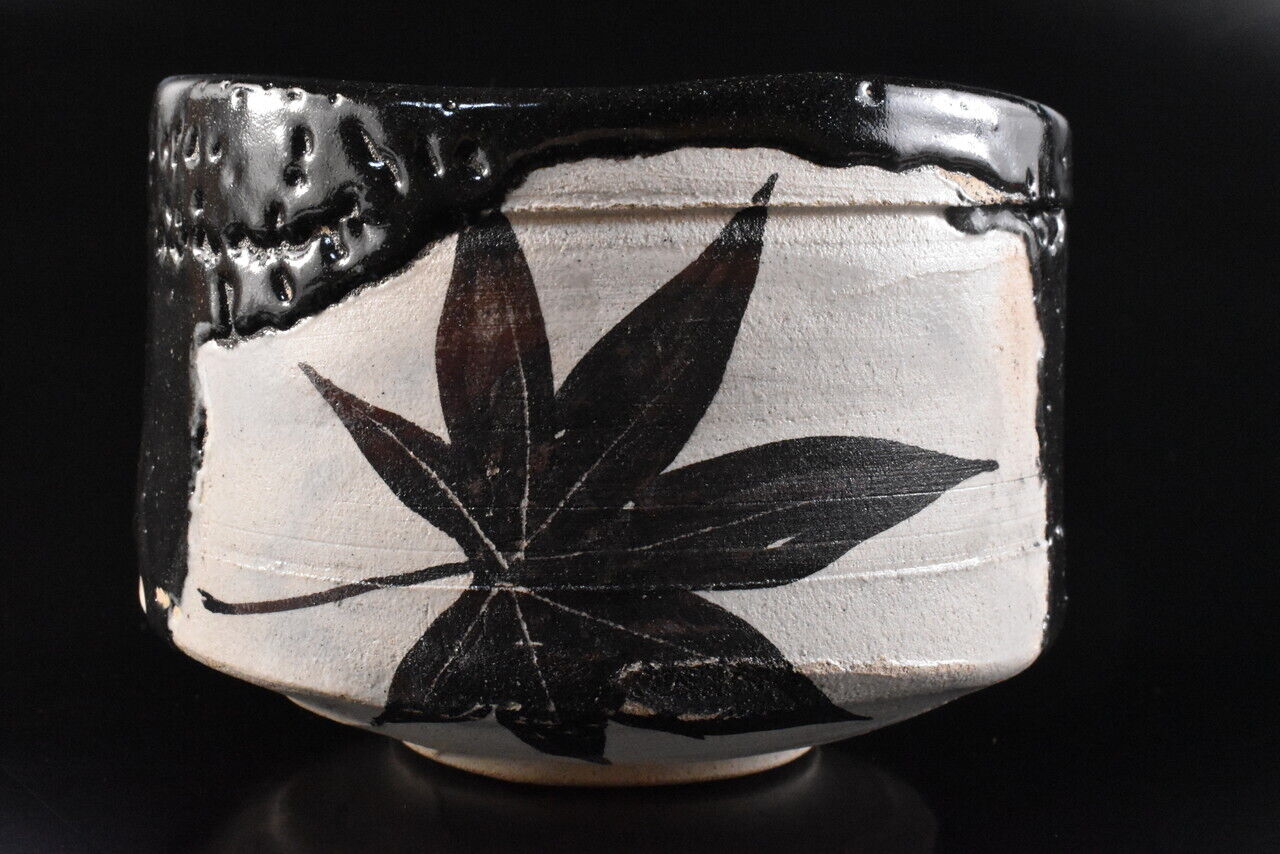
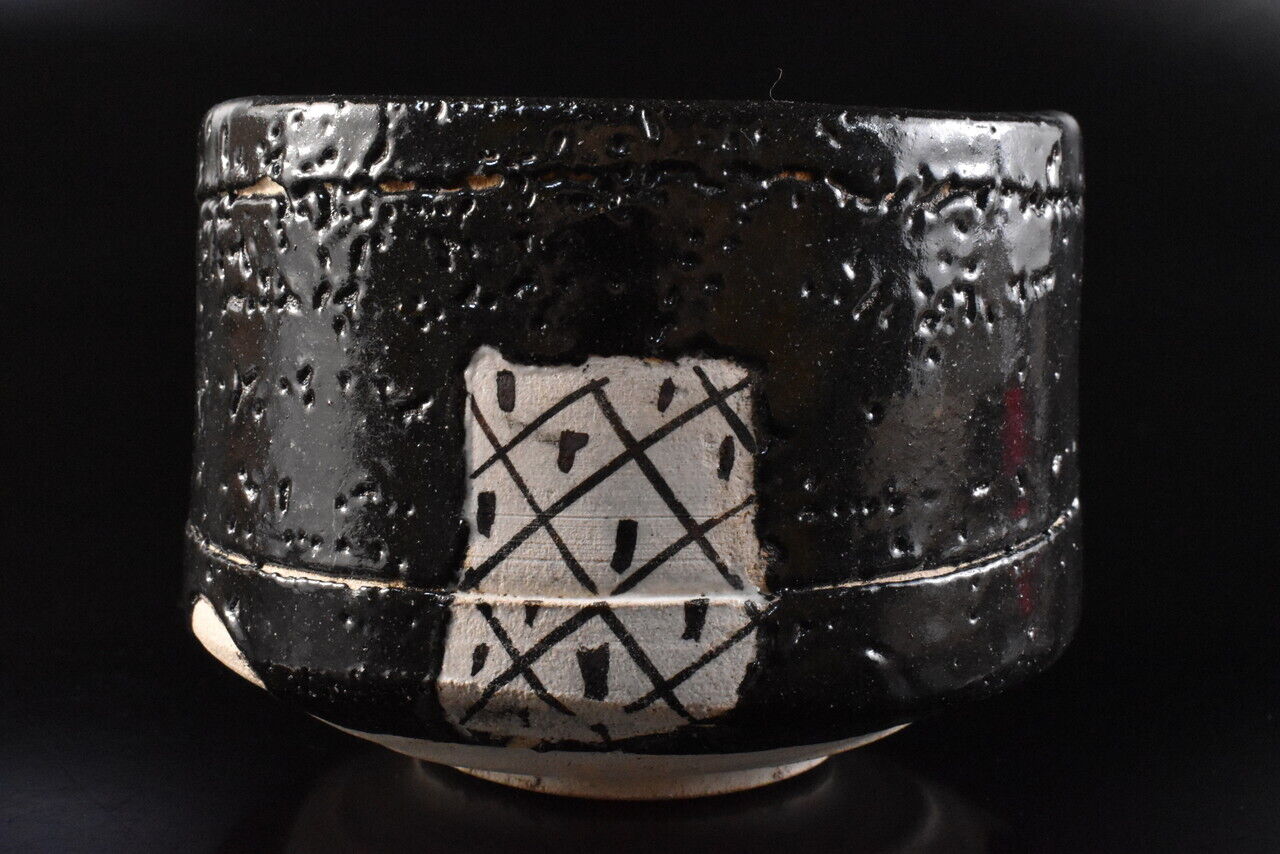
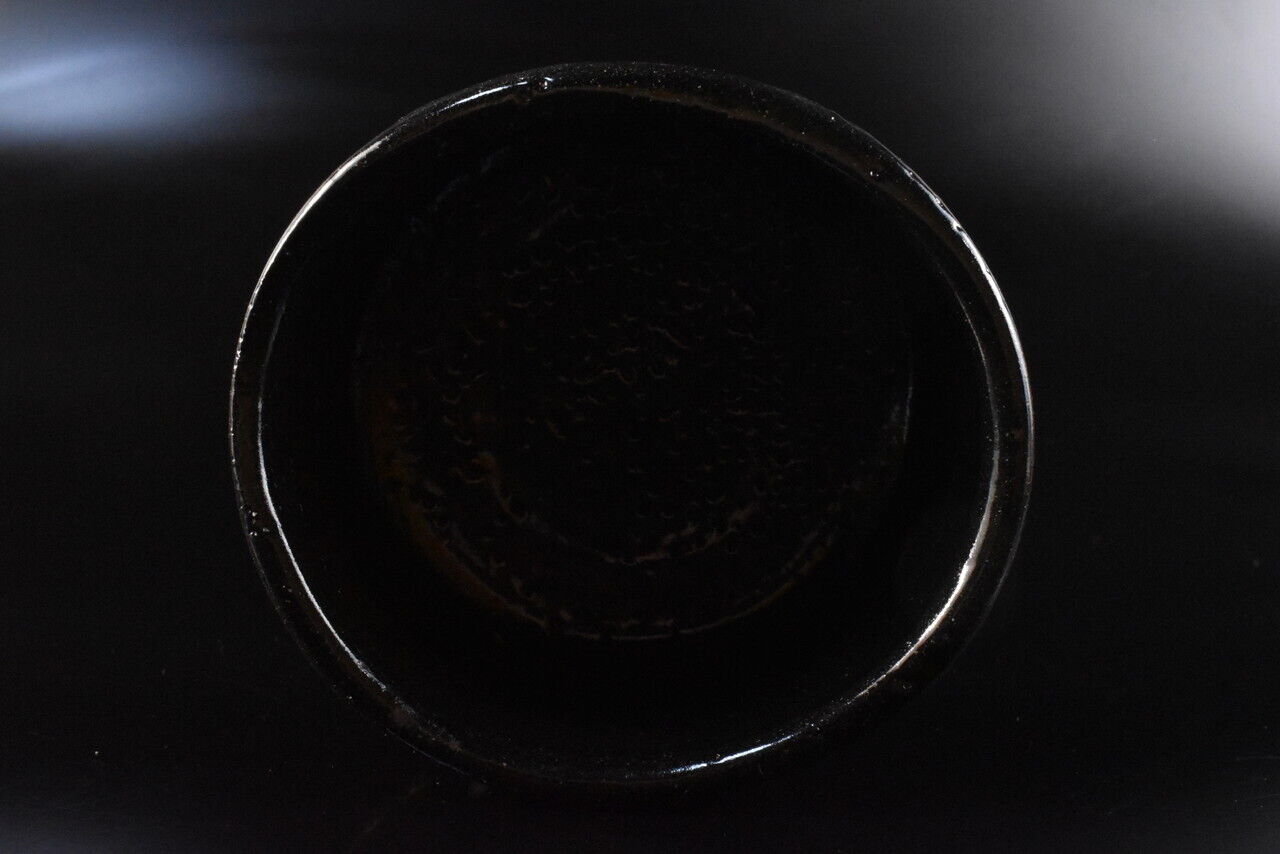
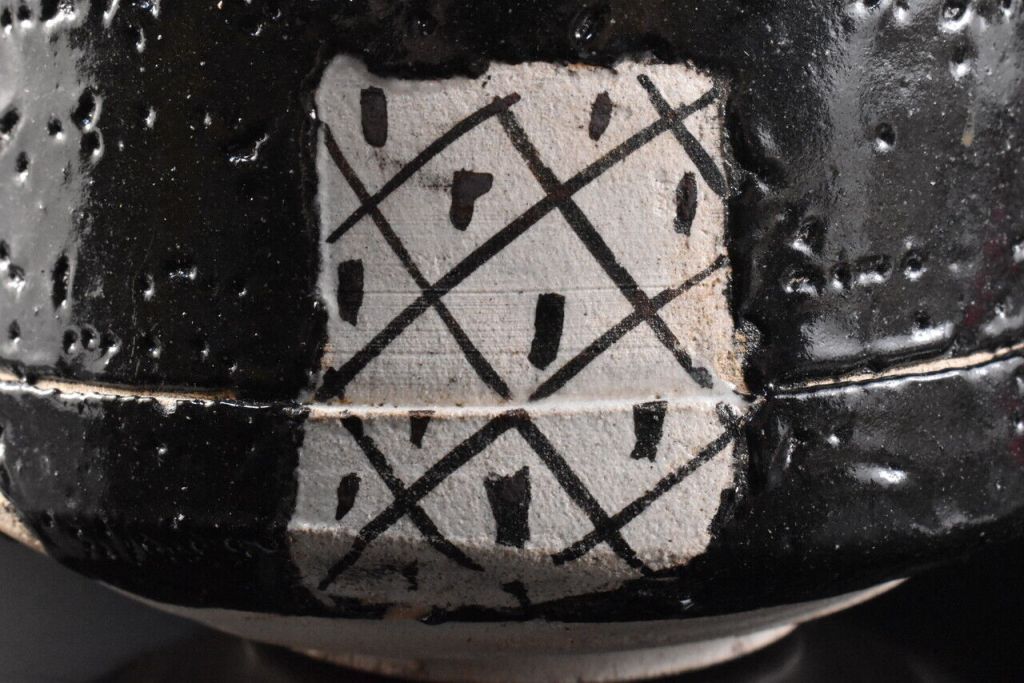
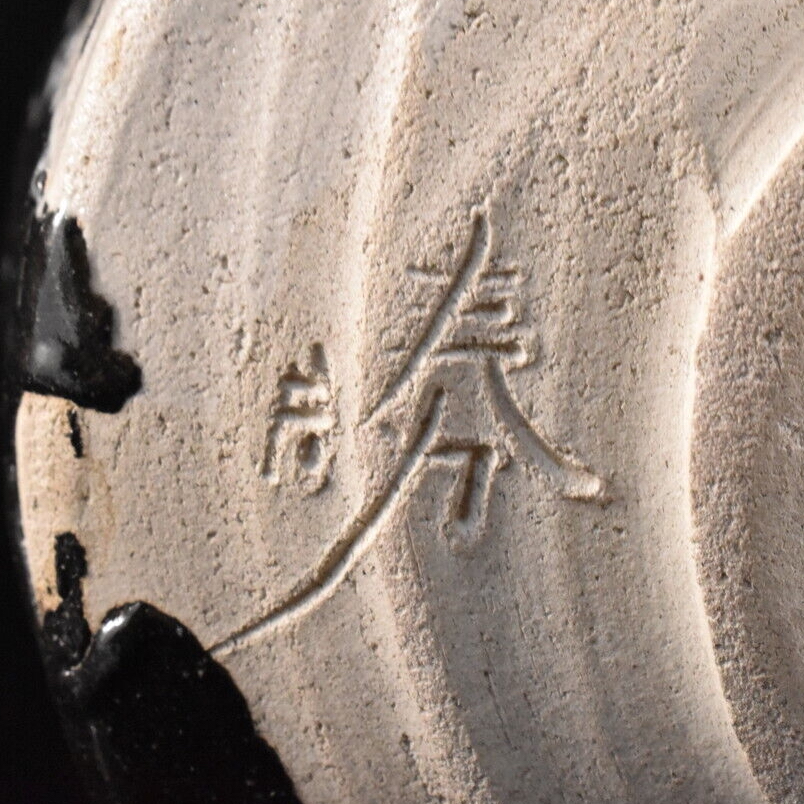
This is a kuro-Oribe or black Oribe style chawan – ceremonial tea bowl made by famed Nitten participant and judge (and one that happens to be a personal favourite), Masaru Kamei (1933-). Stout in shape and with a noticeable presence. It is somewhat sparsely coated with a thick black glaze with on the front a realistic (tracing of?), tree leaf in black and on the reverse a striped motif of diamonds over white. Top to bottom this is a work style that up till now I never saw before from this potter. Definitely and without doubt one of Masaru Kamei’s best works.
Oribe is a visual style named after the late 16th century tea master Furuta Oribe (1544-1615). It’s most often seen in pottery, but extends to textiles and paintings. Oribe was of the Bushi class and not a potter however, he also (like many other influential figures in Japan’s art history), was something akin to an art director or designer. He embodied the spirit of wabi tea so completely that he was able to give it form in a truly new and unique vision. Boldly formed, often intentionally distorted chawan, decorated with green, black and brown glazes and abstract designs appeared on the Tea ceremony scene in Kyoto.
Masaru Kamei is a potter working in the Seto style. He graduated from Aichi Prefectural Seto Pottery Senior High School and then refined his skills under his father. He won his first prize at the Nitten Exhibition in 1953 to be the youngest winner. After receiving his first prize he quit to exhibit his works at any exhibitions for several years to concentrate on creating his original pottery style. Then he established his original style of artworks that is metallic abstract artworks made of black pottery. In my experience most of his work is in the aforementioned style that is very recognizable and limited to this artist. There are however pieces, masterworks such as this Oribe chawan that stand above and surpass his own unique style.
1967 Contemporary Crafts & Arts Exhibition, received the Contemporary Crafts Award 1972 The Foreign Minister’s Award at Japan Modern Art Crafts Exhibition
1973 The Chun-ichi International Ceramic Exhibition Grand Prize
1974 & 1976 Nitten Exhibition Special Award
1992 Aichi Prefecture Arts and Culture Award, Culture Award, Frankfurt City, Germany
1993 Tradition and Avant-garde Crafts Exhibition in Japan Today, Bremen, Germany
1994 The Japan Modern Art Crafts Exhibition Prime Minister Prize
1996 Contemporary Crafts Japan’s New Arts and Crafts Exhibition
Received Aichi prefecture’s Education Award (Culture)
2000 The Japan Modern Art Crafts Exhibition Minister for Education Prize
Received Seto Province’s Public Merit Award
2012 The 44th Nitten Exhibition Minister of Education Prize
Received Minister of Science’s Commendation at the 44th Fine Arts Exhibition of Education, Culture & Sports

Throughout the late Momoyama (1573–1615), and early Edo periods (1615–1868), in Japan, the art of the Japanese tea ceremony underwent new developments. Great tea masters such as Takeno Jōō (1502-1555), Sen no Rikyū (1522-1591), and Furuta Oribe (1544–1615), revolutionized the utensils, rituals and ceramics used in tea ceremonies. As time passed, technology improved and kilns advanced; improved firing conditions allowed the creation of Oribe ware, a new kind of ceramic used in these tea ceremonies.
The motifs, taken from nature or other decorative patterns such as textiles, were ground-breaking in their bold informality. Casting aside Korean and Chinese influences, they were also entirely Japanese. It must have been this recognition of a new Japanese aesthetic that caused tea devotees to cherish Oribe ware. Its ability to capture something of the artistic and spiritual soul of Japan quickly spread throughout the country, and its mass popularity continues to this day.
Masaru Kamei got to be famous as an avant-garde potter in Japan and his outstanding works received many prizes. He also held many trainings abroad and his works has received high evaluation both in and out of the country of Japan.
The chawan has no chips or cracks and is in mint condition. Comes with the original high quality paulownia tomobako or wooden storage box with kiln stamp and calligraphy on the lid. Also includes a dedicated tomonunu or tea cloth.
SOLD
Thank you very much!

In a nutshell, Bunten and Teiten were official, state-controlled, juried art exhibitions. Nitten replaced them after the war. The meaning of these official exhibition societies for the world of Japanese arts was pretty comparable to the French Salon in the second half of the nineteenth century. The conservative Salon was the institution most hated by the French impressionists – their works were regularly rejected by the jury. And without a representation by the Salon, an artist had hardly any chance to sell anything to private collectors.
Masaru Kamei won the Blue-ribbon award at the great Nitten Exhibition in 1974 and in 1976. This is the highest award for potters entering this famously career-making competition.
After the end of the Pacific war the attribute Imperial was no longer trendy. Everything was reorganized and renamed. In 1946 the Imperial Art Academy became The Japan Fine Arts Exhibition, abbreviated as Nitten. The Nitten has developed into a large organization. Today the Nitten has five art faculties, Japanese Style Painting, Western Style Painting, Sculpture, Craft as Art and Calligraphy.
