



Potter: Takuo Katō
Approximate size: W4.7″ by H3.2″ or 12.0 by 8.3 cm
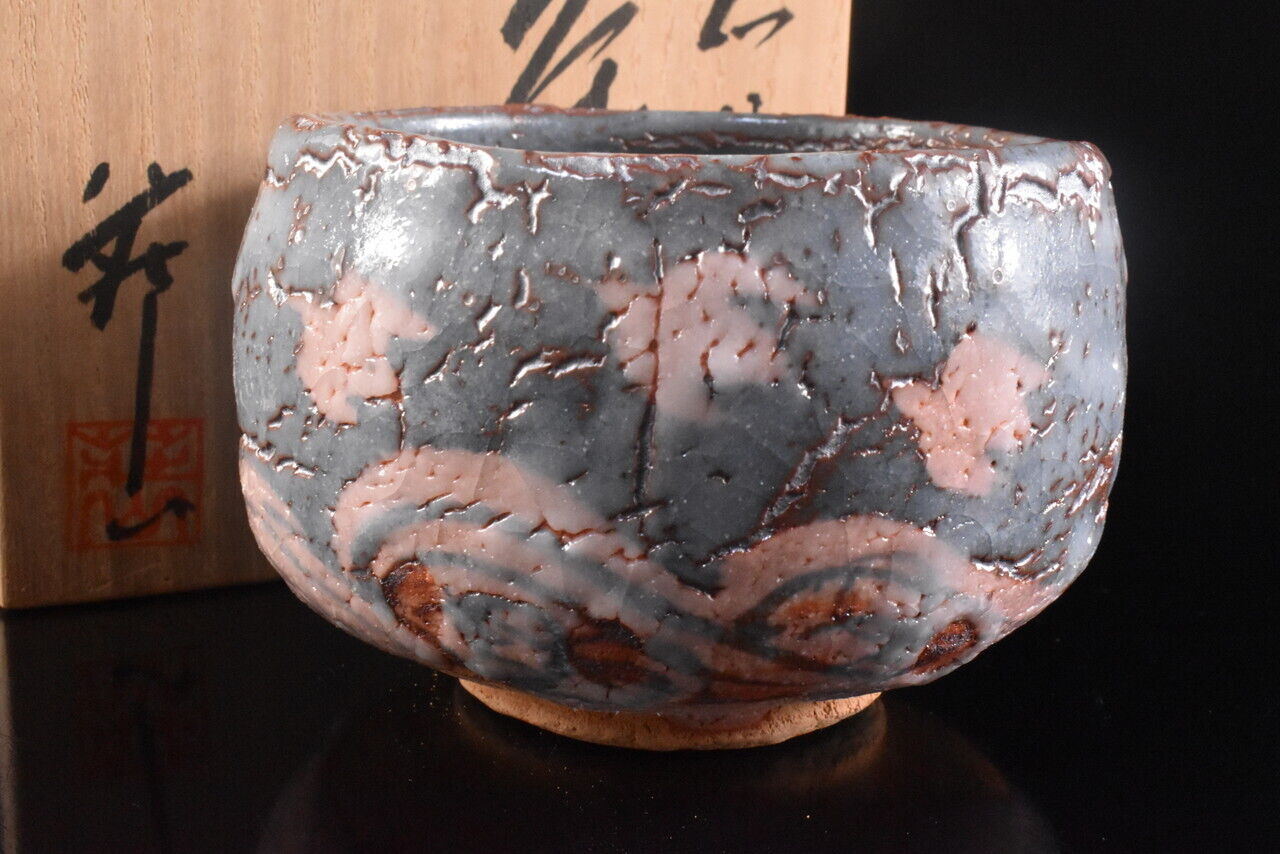
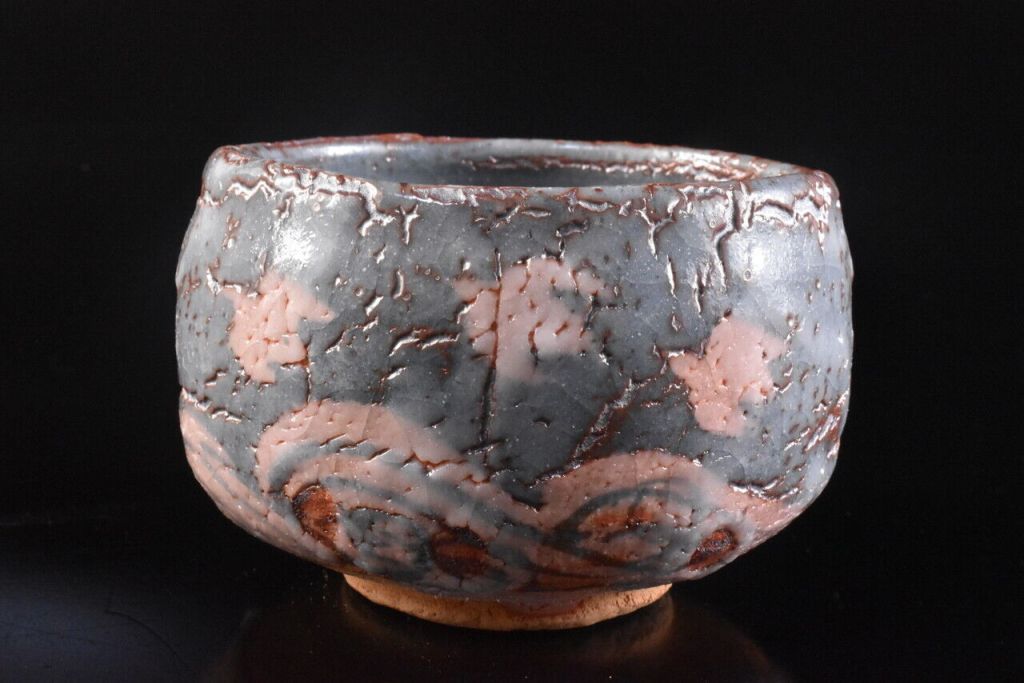
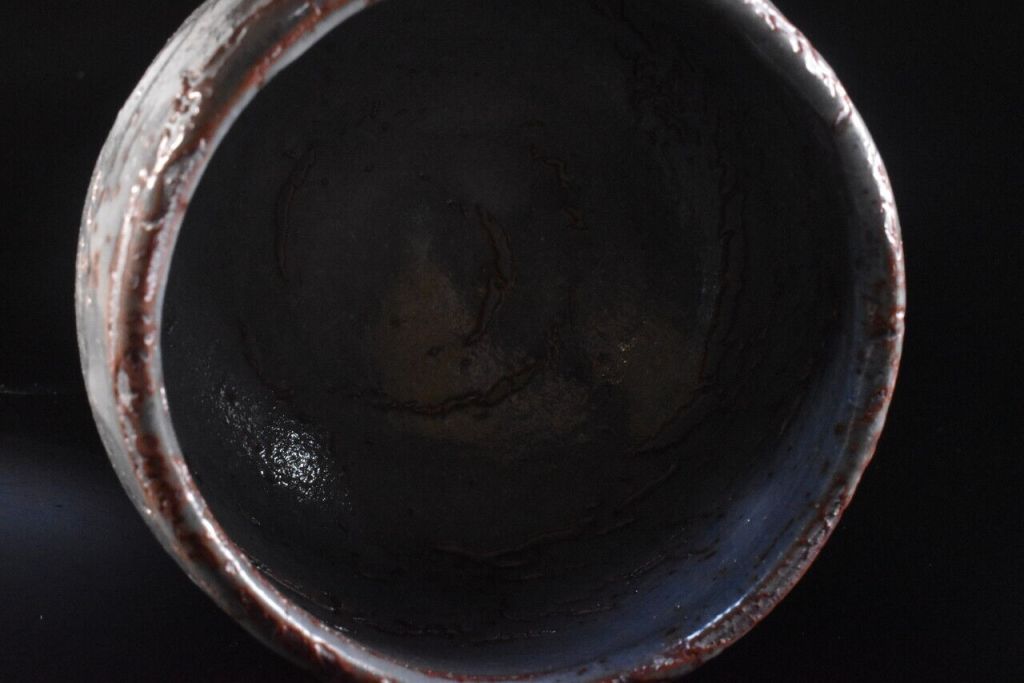
This is a fine blue Shino chawan, ceremonial tea bowl with a motif of bids & waves by a potter that as of yet has eluded me. The work, atmosphere and finish strongly remind me of Toshisada Wakao’s works but I haven’t yet found the time to find out, i.e. conclusively translate the calligraphy and accessories. Hopefully the photos do right to the bowl as it is a very good work. Shino falls under the Mino influence of old, which nowadays is Gifu prefecture. Thrown on a wheel in a round half cylinder shape and carved it is glazed with a white and blue feldspar glaze. The motif of birds is quite quaint as they fly over the waves and gives the chawan a warm atmosphere. With much additional detail I’m relatively sure that whoever the potter is, he or she must be quite the talent. Worth following up on.
December 14th update
My initial feeling of this bowl turned out to be more true than I could’ve imagined. Please read on! This is a rare and valuable chawan or ceremonial tea bowl made by one of the most famous makers in history, none other than Takuo Katō (1917-2005). Born as the first son of the 5th generation Katō Kōbēi his contact with the medium was near instant. He trained at the Kyoto Ceramic Research Center after graduating from Tajimi Technical School. His life then took a quick turn as he was drafted during the war and was also a victim of the atomic bombing of Hiroshima. Unable to make a comeback for a while, he did resume creating pottery in 1955. He was selected for a prize for the first time in the 13th Japan Fine Arts Exhibition the next year. A summarised biography below.
1917 Born in Tajimi City, Gifu Prefecture, Japan
Studied under his father, Katō Kōbē
1935 Graduated from Tajimi Technical School
1938 Enlisted in the Army and served in the military until 1945
1945 Developed leukemia and spent about 10 years fighting the disease
1956 Selected for the first time at Nitten (Japan Fine Arts Exhibition), for a green glazed vase
1961 Invited by the Finnish government to study abroad to exchange designs and techniques
Completed the Finnish School of Arts and Crafts
1963 Purchased by the government for the Hokuto Prize, specially selected at the 6th Nitten (Japan Fine Arts Exhibition)
1965 Awarded the Hokuto Prize, specially selected at the 8th Nitten (Japan Fine Arts Exhibition)
1973 Studied at the Institute of Asian Studies at Pahlavi University in Iran to research Persian ceramics and participated in the excavation of ancient Persian ceramics
Visited the Middle East more than a dozen times since then
1975 Awarded the Chunichi Bunka Prize
for his research on Persian glaze and his teaching and training of Mino ceramics
1980 Commissioned by the Imperial Household Agency to produce a restoration of the Shosoin Three Colour Glaze
1983 Recognised as an Important Intangible Cultural Property by the City of Tajimi and Gifu Prefecture
1986 Held a solo exhibition at the Topkapi Palace Museum in Istanbul, Turkey
1988 Awarded Medal of Honour with Purple Ribbon
1991 Awarded the Gold Prize of the Ceramic Society of Japan
1992 Produced the “Ceramic Monkey Head Ink-stone” as a sacred object for the Ise Shrine’s relocation ceremony
1993 Held a solo exhibition at the Musée de l’Etoile in Paris, France, and received the grand prize of the Mokichi Okada Award from the MOA Museum of Art, Paris, France
1995 Designated as a Living National Treasure and holder of the nationally designated Important Intangible Cultural Property “Sansai” (three color glaze)
1996 Selected as an Honorary Citizen of Gifu Prefecture
2002 “Living National Treasure Takuo Kato Silk Road Rekiteki” exhibition in Tokyo, Osaka, Hokkaido and Nagoya
2005 Died at the age of 87
Received the 5th Oribe Prize Special Award after passing

The first Shino ware was developed during the Momoyama period (1568–1600), in kilns in the Mino and Seto areas. The glaze, composed primarily of ground local feldspar and a small amount of local clay, produced a satiny white colour. It was the first white glaze used in Japanese ceramics. Wares decorated with Shino were fired in the anagama kilns used at that time. Anagama kilns were single-chambered kilns made from a trench in a hillside that was covered with an earthen roof. As the anagama kilns were replaced by the multi-chambered noborigama kilns during the first decade of the 17th century, Shino was supplanted by the Oribe ware glazes used in the newer kilns. Shino enjoyed a brief revival in the 19th century but then seemingly faded into obscurity.
Pottery has been produced in the Mino area of Gifu prefecture since the Kamakura period (the end of the 12th century). The main names synonymous with Mino are Oribe, Shino and ki-Seto. It is said that Shino was the first ware to decorate its pieces with brush-drawn designs as shown on this example. Before the use of brush-drawn decorations potters had been carving, incising or were appliquéing their ideas and fantasies.
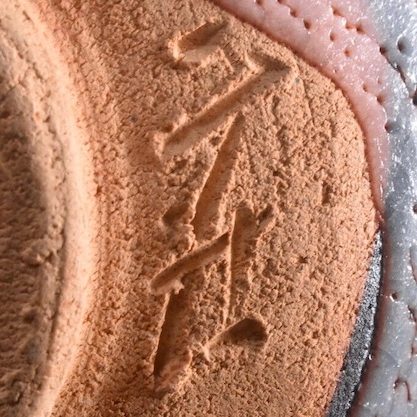
The chawan is signed next to the koudai or foot-ring and is devoid of chips or cracks. Condition is mint. Comes with the original high quality shiho san paulownia tomobako or storage box with the potter’s calligraphy and seal on the lid. There is a signed tomonunu or tea cloth as well.