


Potter: Shirakawa Kitte
Painter: Shimizu Kōshō
Approximate size: W4.7″ by 5.1″ by H3.1″ or 11.9 by 13.0 by 8.0 cm
This chawan is a collaboration between master potter Abe Hajime (known as Shirakawa Kittei and Kikei), and Kōshō Shimizu. Shirakawa Kittei formed and glazed this thin-walled Agano tea bowl and Kōshō used his brush to bring the Zen philosophy to life on its surface before its final glaze firing. The bold black underglaze brushwork depicts a highly stylised, playful figure (highly characteristic of Shimizu Kōshō’s whimsical), childlike painting style (often referred to as dōga or Zen caricature).
The warm cream glaze, smooth texture, and dark iron-brushed details are quite typical of Agano ware, which is based on Kyushu (as Karatsu or Satsuma variants), which Kōshō frequently collaborated with during his lifetime. Shimizu Kōshō, directly brush-painted the playful Zen character onto the clay before its final firing. A work that captured the quintessential balance of Agano ware’s elegance and the simple, natural spirit of Zen calligraphy.
Kōshō Shimizu
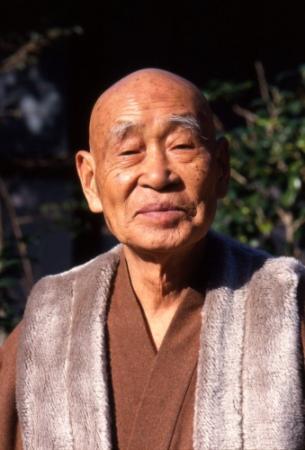
Buddhist monk Kōshō Shimizu (1911-1999), is frequently referred to as the most famous monk of Japan for his long and interesting life. Remembered for his efforts in building and advancing the Tōdai-ji Temple’s educational institutions and also for serving two consecutive terms there as Abbot. He became a monk at the young age of 16 but as far as his artworks are concerned – it was only during what were approximately the last 20 years of his life that he became a prolific creator of calligraphy, paintings, pottery and other endeavours. He’s remembered as having been a eccentric and highly unique artist. His artworks are highly acclaimed and sought after in Japan.
Joining Hogo-in at Tōdai-ji Temple in 1927, he trained under Shimizu Kimitoshi to become a formal Buddhist monk. Before eventually becoming the head Priest he was sent to China during the war from which he returned in 1946. After serving two consecutive terms he retired and became the senior monk at Tōdai-ji Temple and was given the Buddhist Missionary Culture Award.
The body of work he left behind consists of colourful, spontaneous and eccentrically unique objects and paintings. He left behind many works of art with these qualities and quite well-known are his curious Buddha statues. Like in his ceramic work he enjoyed using bright and lively colours in his paintings too, as opposed to many artists who devoted life times to black sumi ink.
In an effort to keep the length of this post within bounds please visit the following page to view a brief overview of his life.

Shirakawa Kittei
The visionary artist-monk Abe Hajime—celebrated by collectors as Shirakawa Kittei—shattered traditional boundaries. Born into the historic lineage of the Totoki Kiln family of Agano, Kittei chose an extraordinary path: rather than working as a solo craftsman, he acted as an elite creative producer (Mokuzō Sōgyō Hachimanjin Zazō). Imagine holding an object that bridges elite Japanese craftsmanship with the highest ranks of Zen Buddhist royalty. In the golden era of post-war tea culture, He leveraged his prestigious status at Nara’s legendary Tōdai-ji Temple to orchestrate historic, “three-way” artistic collaborations that are now considered holy grails in the modern art market.
Kittei worked directly with the 10th and 11th generation grandmasters of the elite Agano-yaki or Agano ware kilns to create pristine, unglazed ceramic bodies He then brought these flawless canvases to the grand Abbot of Tōdai-ji, the world-renowned Kōshō Shimizu, who brushed playful, free-flowing Zen caricatures directly onto the raw clay before firing. In a final, ultimate act of Zen humility, Kittei typically left his own name off the final pieces to let his partners take centre stage. Because he only rarely marked these items, owning one means possessing a breathtakingly rare, multi-layered treasure—a masterful convergence of generational bloodlines and spiritual energy that very few collectors will ever have the chance to hold.
A large part of this website is educational and I hope to give you as the reader further insight into the cultural significance and historical context of the inscription, reflecting the profound appreciation for tea ceremonies in Japanese tradition.
At the same time this post has become quite lengthy and in an attempt to keep the length of this post in check please visit the following page for information about both marks on this chawan and a translation of the calligraphy on the interior of the lid.
Tying everything together, Kittei selected the poetic Mei (soul name), for the bowl, formally inscribing its paulownia tomobako or storage box with the profound Zen idiom Ryuryoku Kako—”Willows are green, flowers are red”—to serve as an ironclad certificate of its elite pedigree and authentic provenance. The bowl appears to be unused and condition of work and appurtenances is mint.
€975 + shipping cost


Old Agano ware chawan are are mostly mumei (unsigned or without any maker’s mark). Few are signed with potter’s name and there are even fewer which bear a date. Starting at the end of the Edo period the Agano ware was being marked with the spiral or ‘tomoe‘.
Until the early 17th century, right-handedness and left-handedness coexisted and were not constant, although a study reported that the left-handedness was constant for works in the upper part of the pottery between 1804 and 1830. Later, after the Meiji era, the style was changed to a kiln marking.
